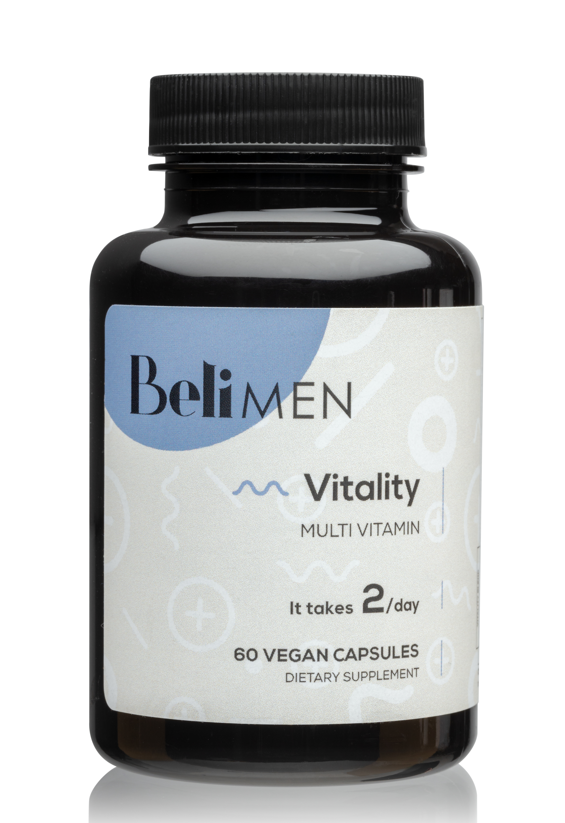
You train. You track your sleep. You know your resting heart rate and probably your VO2 max. But if you're trying to get your partner pregnant, there's one biomarker you've probably never thought about: your sperm.
Here's the part nobody told you. When a couple struggles to conceive, the issue traces back to the man roughly half the time. Not her. You. And yet the entire fertility industry, from the supplement aisle to the doctor's office, still treats conception like it's a women's project. That math doesn't work, because you're supplying half the DNA.
The numbers are moving in the wrong direction
Sperm counts in Western men have dropped by more than half over the past several decades, and the decline appears to be accelerating. Researchers are still arguing about exactly why, but the usual suspects keep showing up: processed food, chronic stress, endocrine-disrupting chemicals in plastics, sedentary living, alcohol, poor sleep. Basically, modern life.
This isn't just about whether you can get her pregnant. Sperm quality affects how quickly conception happens, the odds of miscarriage, and the health of the embryo itself. Damaged sperm DNA doesn't disqualify itself at the starting line. It can fertilize an egg and cause problems downstream. So "we'll just keep trying" isn't a strategy. It's a delay.
The 72-day window most guys don't know about
Here's the good news, and it's genuinely good. Sperm regenerate on a rolling cycle of roughly two and a half to three months. The sperm you're producing today reflect what you ate, drank, and did to your body about 90 days ago. That also means the sperm you'll have in three months reflect what you start doing now.
You can't change your age. You can't change your genetics. But you have a legitimate, biological reset button, and it runs on about a 90-day cycle. That's the entire case for starting a men's prenatal at least three months before you start trying. Not the week of. Not after six months of nothing happening. Now.
Why food alone doesn't get you there
Could you theoretically get everything from a perfect diet? Sure, the same way you could theoretically hit your protein target eating nothing but sardines. In practice, the nutrients that matter most for sperm health need to show up consistently, at meaningful doses, every single day, for months. Supplementation isn't a shortcut. It's insurance on the process.
The catch is that the supplement industry knows men are starting to figure this out, and the shelf is filling up with products that are mostly marketing. So here's how to separate a real men's fertility supplement from an expensive multivitamin in a masculine-looking bottle.
How to know you're choosing the right one
1. It's built around ingredients with actual clinical research behind them. The short list that keeps showing up in the sperm health literature: CoQ10, L-carnitine, zinc, selenium, folate, vitamin D, vitamin E, and vitamin C. These support sperm count, motility (how well they swim), morphology (how well they're built), and protection against oxidative stress, which is one of the biggest drivers of sperm DNA damage. If a product is built around exotic herbs you've never heard of instead of this core, it's built for the label, not for you.
2. The doses match the research, not the marketing. This is where most products fail. A formula can list CoQ10 on the label with a dose so small it's decorative. The industry term is fairy dusting: sprinkle in enough of a trendy ingredient to legally list it, nowhere near enough to do anything. Check that the doses are in the range actually used in studies, not a token amount.
3. No proprietary blends. If the label says "Male Vitality Matrix, 800mg" without telling you how much of each ingredient is inside, that's not proprietary. That's hiding. Reputable brands disclose every dose because they have nothing to bury. Walk away from anything that won't show its math.
4. It uses forms your body can actually absorb. Look for methylated folate instead of synthetic folic acid, since a meaningful share of people carry gene variants that make folic acid harder to process. Chelated minerals over cheap oxides. The nutrient on the label only matters if it ends up in your bloodstream.
5. It's made in the USA in an FDA-registered facility. Supplements are lightly regulated, which means where and how a product is made matters. Look for brands that manufacture domestically in FDA-registered, GMP-compliant facilities. That means the product is made under federal manufacturing standards for quality, cleanliness, and consistency, not in some overseas plant nobody's ever inspected. If a brand can't tell you where its product is made, that tells you everything.
6. It's a fertility formula, not a testosterone booster in disguise. This one trips up a lot of guys. High-dose testosterone boosters and actual testosterone therapy can crater sperm production, sometimes severely. If a product is selling you muscle, energy, and "drive" with fertility as an afterthought, it's the wrong tool. You want a formula designed for sperm health specifically.
7. It's designed for the long game. Because of that 90-day sperm cycle, anything promising results in a week is lying to you. The right product is one you can take daily for three to six months, which also means it should be simple, tolerable, and not require choking down nine horse pills with breakfast.
The bottom line
The 60-Second Checklist: Us vs. Everyone Else
| What to look for | Beli | Typical men's supplement |
|---|---|---|
| Clinically studied fertility ingredients (CoQ10, L-carnitine, zinc, selenium, folate) | ✅ | ⚠️ Some, usually incomplete |
| Doses that match the research, not fairy dusting | ✅ | ❌ |
| Full label transparency, zero proprietary blends | ✅ | ❌ Hidden behind "blends" |
| Methylated folate and absorbable nutrient forms | ✅ | ❌ Cheap synthetic forms |
| Made in the USA in an FDA-registered, GMP-compliant facility | ✅ | ⚠️ Often overseas, often unclear |
| Built for sperm health, not a testosterone booster in disguise | ✅ | ❌ |
| Designed for daily use across the full 90-day sperm cycle | ✅ | ⚠️ Built for a quick sale |
Print it, screenshot it, whatever. If a bottle can't check every box in the left column, put it back on the shelf.
Trying to conceive is one of the few things in life where you and your partner are literally a team of two, and only one teammate has been showing up to practice. A quality men's prenatal isn't about weakness or a problem. It's about controlling the variables you can control, the same way you do with training, sleep, and nutrition.
Start it three months before you want to start trying. Pick one with researched ingredients at real doses, full label transparency, absorbable forms, and made right here in the USA in an FDA-registered facility. Then keep doing the boring stuff that works: sleep, lift, eat real food, ease off the booze, keep the laptop off your lap.
Your future kid gets half their blueprint from you. Make it a good one.
- Do men need a prenatal vitamin? Yes. Male factor contributes to roughly half of fertility challenges, and targeted nutrients like CoQ10, zinc, selenium, and methylated folate support sperm count, motility, and DNA quality.
- When should men start taking a fertility supplement? At least three months before trying to conceive, because sperm take about 90 days to fully regenerate.
- What should I look for in a men's fertility supplement? Clinically studied ingredients at research-backed doses, full label transparency with no proprietary blends, absorbable forms like methylated folate, and manufacturing in a US FDA-registered facility.
- Are testosterone boosters good for fertility? No. High-dose testosterone products can suppress sperm production. Choose a formula designed specifically for sperm health.